


Between February 2025 and June 2026, the aWISH project ran a series of twelve stakeholder workshops that brought together over 600 participants in direct dialogue about the future of animal welfare in Europe’s meat-producing livestock sector. Organised under Task 5.5 (Work Package 5) and led by partners across the consortium, the workshops ranged from online webinars and hybrid conferences to on-farm exchanges, high-level policy debates in Brussels, and international seminars — each addressing a different link in the farm-to-fork chain for pigs and broilers. Together they trace the project’s journey from understanding stakeholder needs, through validating sensor technologies and best practices, to shaping the pathways that will carry animal welfare indicators into policy and everyday practice. This release brings the full series together.
| 12 Workshops Feb 2025 – Jun 2026 | >600 Participants Stakeholders across Europe | Organised by Task 5.5 partners (WP5) |
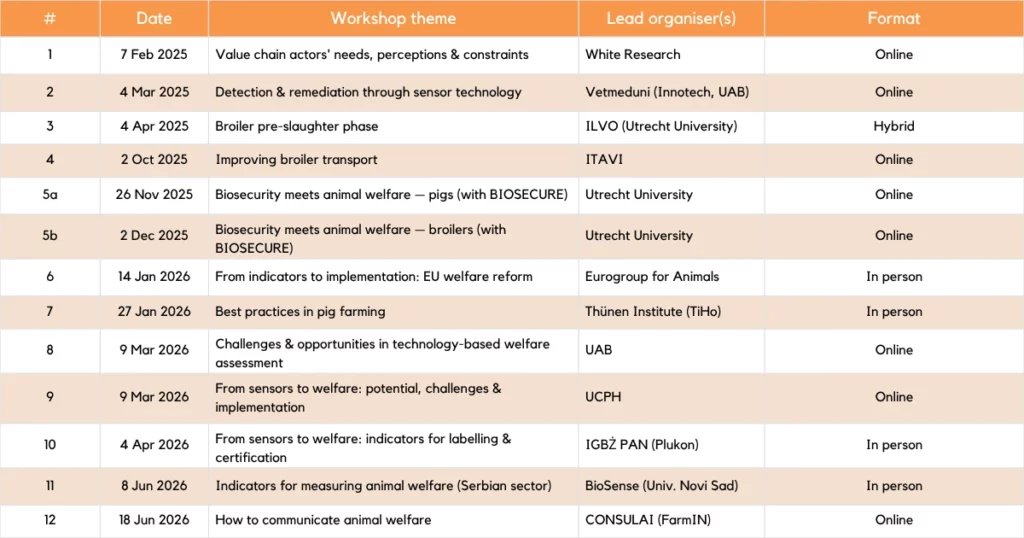
The series at glance
Spring 2025 — Listening to the value chain
The series opened by asking the people who live and work in the value chain what they actually need.
- Value chain actors’ needs, perceptions & constraints (7 February 2025). Organised online by White Research, this first workshop gathered 35 professionals to review findings from stakeholder interviews and a large-scale EU consumer survey. Four priority themes emerged: financial viability (the cost of welfare measures for small farms was the single greatest barrier), consumer trust and labelling (affordability rated the most influential purchase factor at 4.6/5), regulatory fragmentation across Member States, and gaps in monitoring and data.
- Detection and remediation through sensor technology (4 March 2025). Organised by Vetmeduni with Innotech and UAB, 39 stakeholders assessed automated welfare-monitoring systems from providers including ITAVI, CLK, BioSense, FBN and Innotech. The headline conclusion: business models matter as much as the technology, one size does not fit all, and AI-driven detection may ultimately outperform human observation in consistency and objectivity.
- Broiler pre-slaughter phase (4 April 2025). aWISH’s first in-person event, a hybrid workshop at the VAC Ghent auditorium, drew 89 participants around the question ‘How do we catch and transport broilers in 2035?’. Organised by ILVO and Utrecht University, five working groups and a lively panel debate converged on four priorities: human factors are the number-one control point, crate and transport design should be standardised, technology and AI are viable long-term enablers, and regulation must enable rather than obstruct welfare improvement.
Autumn 2025 — Transport, biosecurity and welfare in tension
- Improving broiler transport (2 October 2025). ITAVI hosted 45 participants online to present a Computational Fluid Dynamics (CFD) model that simulates airflow and temperature inside broiler transport trucks, allowing operators to test ventilation, loading density and truck-design interventions against heat stress without costly live trials. Discussion shaped the model’s next steps, from cold-weather applicability to the effect of empty cages and misting during loading.
- Biosecurity meets animal welfare (26 November & 2 December 2025). Co-organised with the sister project BIOSECURE and led by Utrecht University, the fifth workshop ran as two linked sessions, one on pigs (40 participants) and one on broilers (29), tackling the real tension between disease-prevention measures and natural behaviours, such as restricting outdoor access. Rather than simply naming the conflicts, breakout groups co-created solutions around enrichment, outdoor access and genotype choice, laying the groundwork for a follow-up in-person meeting in Utrecht in May 2026.
Early 2026 — From policy to the farm
- From indicators to implementation: pathways for EU welfare reform (14 January 2026). A high-profile workshop at ACE-Events in Brussels, organised by Eurogroup for Animals, brought 50 senior participants, including officials from DG SANTE and DG AGRI, MEPs and Member State representatives, to debate how welfare indicators move from evidence into law. Five conclusions stood out: indicators must be integrated into legislation rather than run parallel to it; EU harmonisation is essential and currently lacking; farmers must be supported, not burdened; multiple policy channels must work in concert; and appetite for continued engagement is strong.
- Best practices in pig farming (27 January 2026). A dialogue between ten practitioners at Haus Düsse’s pioneering ‘barn of the future’, organised by the Thünen Institute and TiHo, focused on reducing tail biting so pigs can keep intact, curly tails. Participants pointed to genetics and stress management as the top levers, early observation and intervention as low-cost wins, and loading as an underappreciated welfare risk , but were unanimous that keeping curly tails ‘has to pay off’. The event sparked plans for a joint event with the Netzwerk Fokus Tierwohl farmer network.
- From sensors to welfare — technology in the slaughterhouse (9 March 2026). Held as two parallel online sessions on the same day, this double workshop examined technology-based welfare assessment from complementary angles. The first session, led by UAB, addressed the challenges and opportunities of technology-based assessment and showcased project-developed detection systems, including corneal-reflex, lung-lesion and tail-length sensors, to 74 participants. The second session, led by the University of Copenhagen (UCPH), focused on the potential, challenges and practical aspects of actually implementing these technologies. Across both, participants ranked the factors that build trust in a welfare technology and pointed to the way forward: common European objectives, transparency in AI-model training, clear cost-benefit cases, and standardisation backed by science.
- Value of indicators for labelling and certification (4 April 2026). Organised by IGBŻ PAN with Plukon, this workshop connected on-farm good practice for broiler welfare with the value of welfare indicators for labelling and certification. Alongside practical guidance on litter, stocking density, enrichment and biosecurity, participants were introduced to digital tools, the EBENE app and the ChickenCheck camera system, and a live slaughterhouse demonstration that showed welfare indicators being assessed in real operating conditions.
Summer 2026 — Reaching new audiences
- Indicators for measuring animal welfare — Serbia (8 June 2026). At the 11th Seminar of Breeding Organisations of AP Vojvodina in Kladovo, the University of Novi Sad and the BioSense Institute introduced aWISH to 160 participants from the Serbian livestock sector. The presentation positioned animal welfare indicators within a national digitalisation drive and showcased the monitoring solutions developed jointly by BioSense and Carnex under Pilot 6.
- How to communicate animal welfare (18 June 2026). Organised online by CONSULAI and FarmIN, around 35 participants explored one of the hardest parts of the welfare agenda: talking about it. A keynote by Catarina Stilwell (FarmIN) framed welfare as a complex, often polarised topic, and discussion turned on the gap between evidence and perception, the pressure of social media and misinformation, and the need to pair science with empathy and transparency.
Common threads across the series
Across twelve very different workshops, a consistent set of messages recurred:
- Welfare has to pay off. From small-farm costs in the first workshop to the curly-tail premium debated in Germany, financial viability was named again and again as the decisive factor in whether welfare improvements are adopted.
- Harmonisation and clear labelling. Stakeholders repeatedly called for EU-wide standards and simpler, transparent claims so that farmers compete on a level playing field and consumers can trust what they buy.
- Human factors and training. Whether catching crews, farm staff or transport operators, the people in the chain emerged as a top control point, while attentiveness, skill and accountability matter as much as equipment.
- Technology and AI, with a business case. Sensors and automated slaughterhouse monitoring promise more consistent, objective assessment, but only where the cost-benefit ratio works for users and providers alike.
- Measuring welfare at the slaughterhouse. Slaughterhouse-based assessment recurred as the most objective and scalable way to reflect on-farm outcomes back to producers.
- Communication and cooperation. Ultimately, welfare gains depend as much on dialogue, trust and collaboration across actors as on the underlying science.
What comes next
As aWISH moves towards its final outputs in 2026, the workshop series has built a durable, engaged network spanning producers, processors, technology providers, NGOs, veterinary and certification bodies, researchers and policymakers across Europe. The project’s closing deliverables draw directly on the insights captured across these twelve workshops. The conversations begun here are set to continue well beyond the project’s lifetime.
About aWISH aWISH (Animal Welfare Improvement Strategies for Healthy livestock) is a Horizon Europe project (GA No. 101060818) developing scalable, cost-efficient solutions to evaluate and improve the welfare of meat-producing livestock, pigs and broilers, across Europe. The project runs from 2022 to 2026 and is built on a multi-actor approach involving producers, processors, policymakers, NGOs, and citizens. www.awish-project.eu
For more information contact the coordinating team | ILVO | awish@ilvo.vlaanderen.be or akyriakidis@white-research.eu