


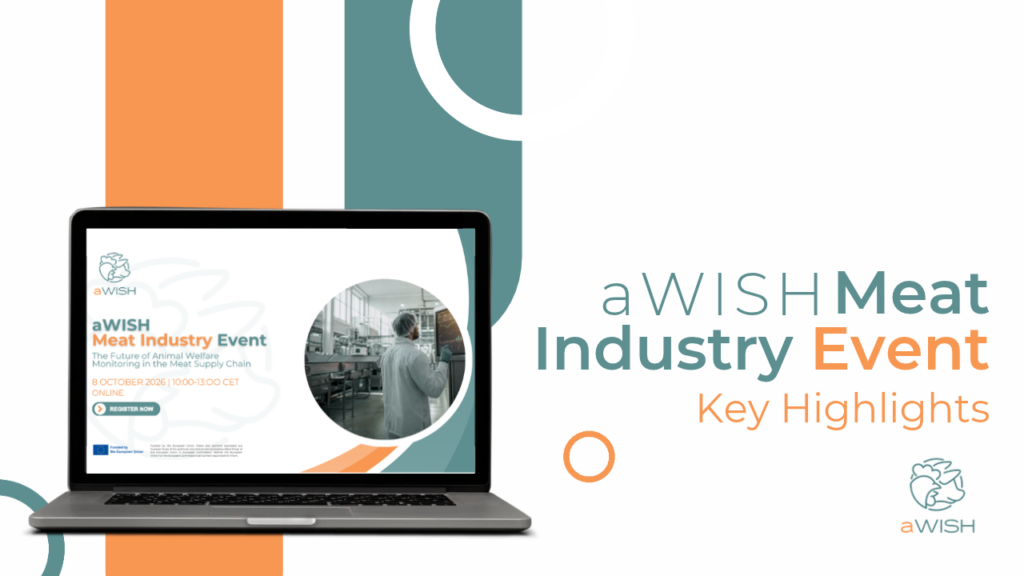
On 8 October 2026, the aWISH project held its online Meat Industry Event, “The Future of Animal Welfare Monitoring in the Meat Supply Chain”. Organised by INNOVACC, ILVO and Consulai, it gathered 108 participants, including researchers, technology providers, slaughterhouse representatives and animal welfare organisations.
The main message of the day: automated welfare monitoring only creates value when reliable indicators are turned into management actions and verified improvements.
From pilots to practice
The event opened with an overview of aWISH: 28 partners in 11 countries and six pilot sites, four for pigs and two for broilers. Researchers and pilot partners from ILVO, Utrecht University, TiHo, Thünen Institute, Batallé and Plukon then presented the technologies tested in the project.
For pigs, these included WeightDetect, acoustic monitoring of stress-related vocalisations, Blink AI for stunning effectiveness, LesionDetect for lung lesions and PigInspector for tail, ear and skin indicators. For broilers, they included an on-farm camera system, a transport heat-stress model and ChickenCheck for footpad dermatitis, hock burns and catching-related injuries.
In the broiler pilots, automated and trained human lesion assessments showed strong agreement. Pilots in France (27 flocks) and Poland (285 flocks) also linked litter quality and bedding type to footpad health, and a Dutch pig intervention on ten farms linked climate-management advice to lower ammonia exposure and fewer coughing events.
Pilot representatives from Batallé and Plukon described what installation in a real slaughterhouse involves: site adjustment, algorithm training, validation and integration into daily workflows, alongside challenges such as noise, humidity, cleaning, processing speed and staff acceptance.
Data and guidance for the whole chain
Ubitech presented the aWISH Data Platform, which integrates data from farms, transport and slaughterhouses and offers dashboards, benchmarking, access controls and alerts.
The project also developed nine Best Practice Guides: four for pigs, four for broilers and one on monitoring and feedback systems. They are built around a simple improvement cycle: monitor, analyse, act and evaluate.
A session led by Eurogroup for Animals then looked at opportunities for future uptake by the meat industry, including feedback to producers, welfare assurance and transparent communication
Round table: creating value from welfare data
The final round table, “Animal Welfare Data: Creating Value Across the Meat Supply Chain”, was moderated by UAB, with panellists from Norfrisa, Plukon, Symrise, BBFAW, Eurogroup for Animals and Innotech Vision. Participants agreed on several points:
- Monitoring technologies must be scientifically validated and perform consistently under commercial conditions.
- Harmonised definitions, methods and interoperable data are needed before results can be compared between sites or countries, or used for benchmarking and certification.
- Welfare data should drive prevention and continuous improvement, rather than being used mainly to sanction.
- Automated systems should support professional judgement, not replace it, and should not focus only on what is easiest to measure.
- Better welfare does not automatically mean consumers will pay more, so realistic business models and incentives are needed.
The discussion confirmed that progress will depend on collaboration across the supply chain. The success of automated monitoring should be measured not by the amount of data collected, but by its contribution to better decisions and measurable improvements in animal welfare.