



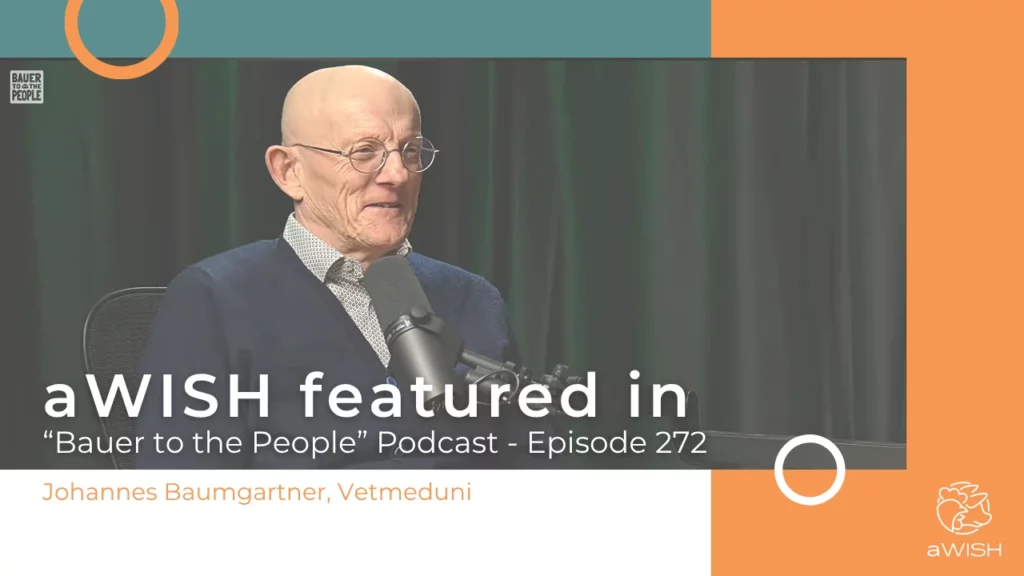
The aWISH project is featured in a new episode of the “Bauer to the People” podcast, which explores how digital technologies can support the assessment of animal welfare in livestock production.
In this episode, Johannes Baumgartner from the University of Veterinary Medicine Vienna represents the aWISH project and discusses how digital tools are being developed and tested to make animal welfare more visible and measurable in practice. Drawing on decades of experience, he explains how aWISH research focuses on identifying reliable, animal‑based welfare indicators that can be assessed automatically using camera‑based systems.
A central topic of the conversation is the pig’s tail as an animal‑based welfare indicator. The tail is considered an “iceberg indicator”, as its condition reflects multiple underlying welfare aspects throughout the animal’s life. The episode highlights how camera‑based monitoring can assess tail condition with high accuracy, closely matching manual reference assessments, and how this offers strong potential for large‑scale, objective welfare monitoring.
The discussion also addresses current limitations and challenges identified through aWISH research. While digital assessment performs well for tail condition, other welfare indicators, such as skin lesions or lung health, remain more difficult to assess automatically. Differences in expert interpretation of the same images underline the importance of scientific validation and robust reference data when developing AI‑based welfare monitoring tools.
Beyond the technical aspects, the episode reflects on the gap between scientific knowledge, technological potential, and on‑farm realities. By grounding the discussion in factual examples, the conversation illustrates how aWISH aims to support evidence‑based improvements in animal welfare while acknowledging practical and economic constraints.
Overall, the podcast provides an in‑depth look at how aWISH contributes to advancing data‑driven, objective, and scalable animal welfare monitoring, while raising broader questions about implementation, responsibility, and the cost of improving animal welfare in practice.
🎧 Listen to the podcast episode here!